Authors: Jesse Bruhn, Nathan Jones, Yasuko Kanno, and Marcus A. Winters
Published in Education Evaluation and Policy Analysis (Dec 2022) ↗
Project summary
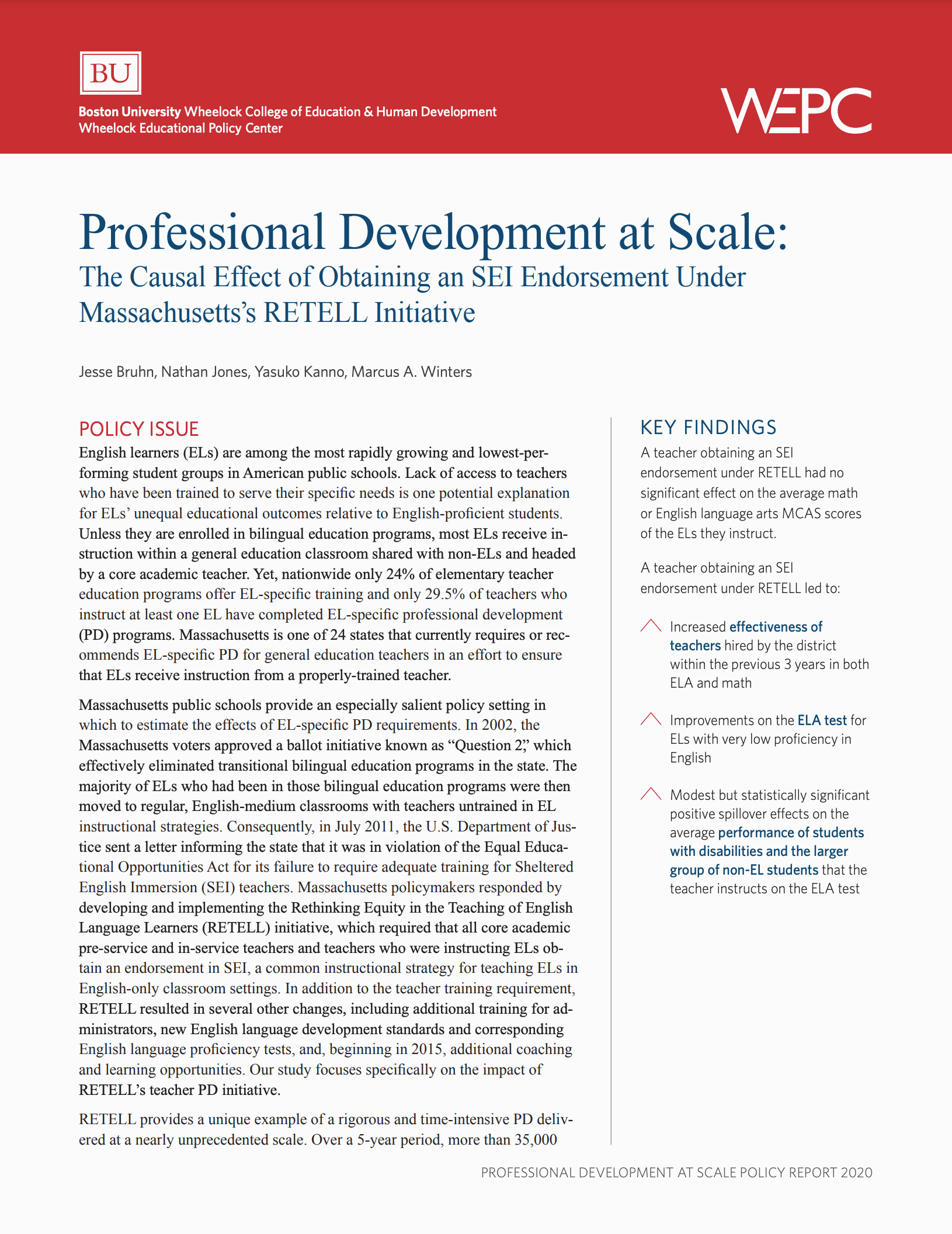
English learners (ELs) are among the most rapidly-growing and lowest-performing student groups in American public schools. Lack of access to teachers who have been trained to serve their specific needs is one potential explanation for ELs’ unequal educational outcomes relative to non-EL students. Jesse Bruhn, Nathan Jones, Yasuko Kanno, and Marcus Winters use longitudinal data from Massachusetts to measure the causal effect of a rigorous and time-intensive professional development (PD) delivered at a nearly unprecedented scale: teachers earning an endorsement in Structured English Immersion (SEI) under the Massachusett’s Rethinking Equity in the Teaching of English Language Learners (RETELL) initiative. RETELL required that all core academic pre-service and in-service teachers who were instructing ELs obtain an endorsement in SEI, which is a common instructional strategy for teaching ELs in English-only classroom settings. Over a 5-year period, more than 35,000 in-service public school teachers throughout Massachusetts obtained the endorsement, which for most required completing a training equivalent in scope to a college-level semester-long course.
Key Findings
A teacher obtaining an SEI endorsement under RETELL had no significant effect on the average math or English language arts Massachusetts Comprehensive Assessment System (MCAS) scores of the ELs they instruct. The analysis did not detect a significant difference in the effect of a teacher completing the full, long-bridge, or short-bridge training on their student’s test scores.
However, the training did lead to: 1) increased effectiveness of teachers hired by the district within the previous 3 years (a proxy for teacher experience) in both English Language Arts (ELA) and math; 2) improvements on the ELA test for ELs with very low proficiency in English; 3) modest but statistically significant positive spillover effects on the average performance of students with disabilities and the larger group of non-EL students that the teacher instructs on the ELA test.
Related news