
Research
Our research
Featured topics




The Effects of Grade Retention in Indiana Schools
Analysis of the impacts of the threat of grade retention and retention itself in Indiana public schools.

Air Pollution and Learning
A policy brief highlighting new findings on the negative effects of air pollution on school learning and the discrepancy in who bears the brunt of the effects.
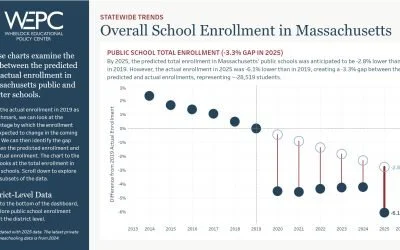
Massachusetts School Enrollment Dashboard
This interactive dashboard examines the gap between the predicted and actual enrollment in Massachusetts public, private, charter, and home schools.

Teacher Shortages in Connecticut
The Wheelock Educational Policy Center, in partnership with the Connecticut State Department of Education, tracks where and why staffing shortages persist in Connecticut's public schools. These reports identify shortage areas across special populations, general education subjects, and school support personnel—and examine how those gaps fall unevenly across districts. Together, the 2023 and 2025 editions show how the state's staffing challenges have evolved over time.

Guardrails or Barriers
This white paper from the BU Wheelock Educational Policy Center seeks to summarize some of what we know from the literature and highlight related policy considerations surrounding teacher licensure.

Massachusetts School Leader Workforce – Annual Snapshots
Graphic snapshots showcasing the characteristics, career trajectories, and outcomes of principals and assistant principals in Massachusetts public schools.

Special Education Substantially Improves Learning: Evidence from Three States
Special education serves more than one in seven U.S. students, yet its causal impact remains understudied. In this paper, we estimate the effect of individualized supports with an event-study design that tracks achievement around initial classification. The research shows students’ scores decline prior to placement and rise sharply afterward. Overall, individualized supports substantially increase learning productivity.

Assessing the Potential Impact of Seniority-Based Reduction in Force Policies on the Changing Teacher Workforce in Connecticut Schools
Given statewide patterns in the composition, distribution, and effectiveness of newly hired teachers, layoffs that prioritize seniority are likely to cause disproportionate disruption to the teacher workforce in Connecticut, especially in schools serving vulnerable populations.

School Enrollment Shifts Five Years After the Pandemic
This research documents the changes in public school enrollment in one state and highlights shifts that may have broader implications for American schools.

Service Delivery Models: Impacts for Students With and Without Disabilities
This research study offers some of the field’s first causal evidence of how different service delivery models impact student achievement and behavior.

English Learners’ Access to Massachusetts Early College Programs
The authors of this study examined the extent to which English learners are participating in Massachusetts Early College programs.

Reclassifying English Learners
The authors of this study use data from Indiana to examine the causal effects of English learner reclassification on later student outcomes, including test scores and attendance rates.

Understanding Special Education Services at Scale Using IEP Data
Indiana requires schools to submit student Individualized Education Programs (IEPs) into a centralized database, making it possible to analyze IEPs on a statewide scale and uncover novel insights about their content. Using rigorous quantitative methods, WEPC researchers are identifying patterns related to IEP goals, services, placements, and more.

Forecasting the Supply and Demand of Diverse Educators
The increasing diversity of students in Massachusetts makes growing a diverse educator workforce a critical policy goal for the Commonwealth. In recent years, state and local leaders have responded to this challenge with a variety of programs and policy changes. This report details these efforts and their considerable impact to date. However, the findings show the racial and ethnic differences between the state’s students and teachers will continue to widen through the end of this decade, if Massachusetts remains on the current trajectory. Employing a projection model developed by researchers at the Wheelock Educational Policy Center, the analysis models several hypothetical scenarios to close the gap. The report concludes with policy recommendations to accelerate the pace of change.

Examining the Supply of New Special Educators
Special education teacher shortages have been a consistent problem around the U.S. for decades and have only grown since the start of the COVID-19 pandemic. In this context, reports of declining interest in special education among prospective teachers are especially concerning. The authors of this study examined the supply of new special education teachers into the workforce and the institutions that are supplying them, shedding light on the increasingly prominent role of for-profit alternative certification programs in the preparation of special education teachers.

Who Benefits from Remote Schooling?
To avoid pandemic-induced teacher shortages, Massachusetts implemented an emergency license, removing most traditional licensure requirements for individuals who wanted to become teachers. This study reports on the first cohort of teachers employed on the license.

Comparing Turnover Intentions and Actual Turnover in the Public Sector Workforce
When teachers choose to leave their jobs, it can be disruptive and costly for their school and district, affecting everything from student learning to the experiences of other teachers and staff. For this reason, policymakers have been worried by indications that many teachers are thinking about leaving the profession. But just how reliable are these warning signs that teachers are thinking of leaving? In this study, a group of researchers aimed to understand the relationship between teachers’ self-reported intentions to leave the profession or transfer schools and their actual turnover.

Licensure Tests and Teacher Supply in Connecticut
This research project uses longitudinal data from Connecticut to examine the association between teachers’ performance on required subject-matter licensure tests (specifically, the Praxis II assessment suite) and their later effectiveness at improving student test scores. The authors then estimate the causal effect of failing a first attempt at one of these Praxis II tests on an individual’s likelihood of eventually becoming a licensed teacher in the state.

Deconstructing the EL Gap
Across U.S. schools, students classified as English learners (ELs) tend to achieve lower educational outcomes than their non-EL peers. What explains these differences? Are they a product of ELs’ developing English language proficiency and/or the services they receive at school, or do other factors play a role? The authors of this study attempt to deconstruct the “EL gap” in Massachusetts by examining the extent to which differences in outcomes between ELs and non-ELs can be attributed to factors that are unrelated to a student’s English proficiency or receipt of EL services.

Disparate Teacher Effects, Comparative Advantage, and Match Quality
A teacher who is effective with one group of students but ineffective with another could either reduce or exacerbate educational inequality. Understanding disparate impacts of teachers based on students’ race can help design policies and practices to improve the efficiency and equity of education systems.