
Research
Our research
Featured topics



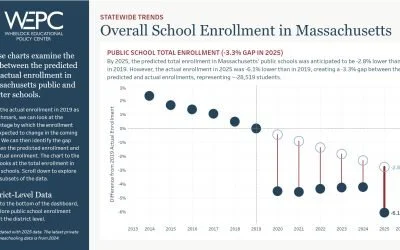
Massachusetts School Enrollment Dashboard
This interactive dashboard examines the gap between the predicted and actual enrollment in Massachusetts public, private, charter, and home schools.

Massachusetts School Leader Workforce – Annual Snapshots
Graphic snapshots showcasing the characteristics, career trajectories, and outcomes of principals and assistant principals in Massachusetts public schools.

Special Education Substantially Improves Learning: Evidence from Three States
Special education serves more than one in seven U.S. students, yet its causal impact remains understudied. In this paper, we estimate the effect of individualized supports with an event-study design that tracks achievement around initial classification. The research shows students’ scores decline prior to placement and rise sharply afterward. Overall, individualized supports substantially increase learning productivity.

Examining Wage Growth in ECE Programs: Evidence from Massachusetts
Analysis of Massachusetts early educator wage growth. Review of changes in early educator wages over several years. Shows modest inflation-adjusted wage gains that are still significantly below ideal levels.

Early Returns: Reversing Enrollment Declines in Massachusetts Community Colleges through MassReconnect
Analysis of Massachusetts MassReconnect free community college program. Evaluates enrollment impact, student demographics, financial aid distribution, and persistence rates for free tuition initiative targeting adults 25+. Policy brief for states considering free college programs.

School Enrollment Shifts Five Years After the Pandemic
This research documents the changes in public school enrollment in one state and highlights shifts that may have broader implications for American schools.

English Learners’ Access to Massachusetts Early College Programs
The authors of this study examined the extent to which English learners are participating in Massachusetts Early College programs.

Early Education Workforce Supports at Scale
This white paper from the BU Wheelock Educational Policy Center seeks to outline the opportunity and imperative of building data and research capacity at the state level specific to improving our understanding of the ECE workforce.

Forecasting the Supply and Demand of Diverse Educators
The increasing diversity of students in Massachusetts makes growing a diverse educator workforce a critical policy goal for the Commonwealth. In recent years, state and local leaders have responded to this challenge with a variety of programs and policy changes. This report details these efforts and their considerable impact to date. However, the findings show the racial and ethnic differences between the state’s students and teachers will continue to widen through the end of this decade, if Massachusetts remains on the current trajectory. Employing a projection model developed by researchers at the Wheelock Educational Policy Center, the analysis models several hypothetical scenarios to close the gap. The report concludes with policy recommendations to accelerate the pace of change.

Deconstructing the EL Gap
Across U.S. schools, students classified as English learners (ELs) tend to achieve lower educational outcomes than their non-EL peers. What explains these differences? Are they a product of ELs’ developing English language proficiency and/or the services they receive at school, or do other factors play a role? The authors of this study attempt to deconstruct the “EL gap” in Massachusetts by examining the extent to which differences in outcomes between ELs and non-ELs can be attributed to factors that are unrelated to a student’s English proficiency or receipt of EL services.

Evaluating Emergency Licensure in Massachusetts
To avoid pandemic-induced teacher shortages, Massachusetts implemented an emergency license, removing most traditional licensure requirements for individuals who wanted to become teachers. This research reports on initial impacts on composition and quality of the workforce.

Enrollment Flexibility and Charter School Impacts: The Effect of Backfill on Students in Massachusetts Charter Middle Schools
This study leverages Massachusetts’s adoption of a statewide requirement for charter schools to backfill vacancies within some grades to provide the first causal estimates for the effect of incorporating new students on the performance of incumbent charter school pupils. Using data from the universe of Massachusetts public school students enrolled in Grades 5 through 8 from 2007-2008 to 2013-2014, this study compares changes in student achievement in impacted vs. not-impacted grades within Boston charter schools to the patterns of student achievement within traditional public schools and charter schools outside of Boston.

Ability Signals and Rigorous Coursework: Evidence from AP Calculus Participation
The study examines how one signal of ability—whether a student achieves “Advanced” status on Massachusetts’ 10th grade statewide standardized assessment—effects subsequent enrollment in Advanced Placement (AP) Calculus courses. Short answer: it does, but not equally.

COVID-19 and the Composition of the Massachusetts Teacher Workforce
With fears of teacher shortages mounting amidst the pandemic, the Wheelock Educational Policy Center examines actual changes in the composition and demographics of the teacher workforce in Massachusetts.

Professional Development at Scale: The Causal Effect of Obtaining an SEI Endorsement Under Massachusetts’s RETELL Initiative
This project used longitudinal data from Massachusetts to measure the causal effect of a rigorous and time-intensive professional development (PD) delivered at a nearly unprecedented scale: teachers earning an endorsement in Structured English Immersion (SEI) under the Massachusett’s Rethinking Equity in the Teaching of English Language Learners (RETELL) initiative.

Regulatory Arbitrage in Teacher Hiring and Retention
Authors compared Massachusetts longitudinal administrative data on the relationship of teacher value-added and attrition between charter and public schools.

Are Two Teachers Better than One? The Effect of Co-Teaching on Students with and without Disabilities
Using longitudinal data for students and teachers in Massachusetts, researchers estimated the effect of co-teaching within a large public school system.