
Research
Our research
Featured topics




The Effects of Grade Retention in Indiana Schools
Analysis of the impacts of the threat of grade retention and retention itself in Indiana public schools.

Understanding ECE Workforce Needs in Massachusetts
Analysis of recent investments in ECE programs in Massachusetts. Shows that a stronger workforce is key to meeting demand.

Air Pollution and Learning
A policy brief highlighting new findings on the negative effects of air pollution on school learning and the discrepancy in who bears the brunt of the effects.
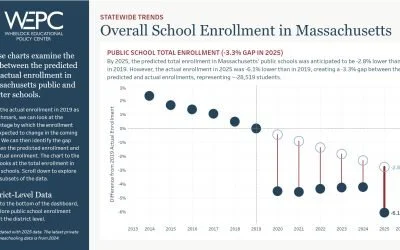
Massachusetts School Enrollment Dashboard
This interactive dashboard examines the gap between the predicted and actual enrollment in Massachusetts public, private, charter, and home schools.

Teacher Shortages in Connecticut
The Wheelock Educational Policy Center, in partnership with the Connecticut State Department of Education, tracks where and why staffing shortages persist in Connecticut's public schools. These reports identify shortage areas across special populations, general education subjects, and school support personnel—and examine how those gaps fall unevenly across districts. Together, the 2023 and 2025 editions show how the state's staffing challenges have evolved over time.

Guardrails or Barriers
This white paper from the BU Wheelock Educational Policy Center seeks to summarize some of what we know from the literature and highlight related policy considerations surrounding teacher licensure.

Massachusetts School Leader Workforce – Annual Snapshots
Graphic snapshots showcasing the characteristics, career trajectories, and outcomes of principals and assistant principals in Massachusetts public schools.

Special Education Substantially Improves Learning: Evidence from Three States
Special education serves more than one in seven U.S. students, yet its causal impact remains understudied. In this paper, we estimate the effect of individualized supports with an event-study design that tracks achievement around initial classification. The research shows students’ scores decline prior to placement and rise sharply afterward. Overall, individualized supports substantially increase learning productivity.

Examining Wage Growth in ECE Programs: Evidence from Massachusetts
Analysis of Massachusetts early educator wage growth. Review of changes in early educator wages over several years. Shows modest inflation-adjusted wage gains that are still significantly below ideal levels.

Early Returns: Reversing Enrollment Declines in Massachusetts Community Colleges through MassReconnect
Analysis of Massachusetts MassReconnect free community college program. Evaluates enrollment impact, student demographics, financial aid distribution, and persistence rates for free tuition initiative targeting adults 25+. Policy brief for states considering free college programs.

Assessing the Potential Impact of Seniority-Based Reduction in Force Policies on the Changing Teacher Workforce in Connecticut Schools
Given statewide patterns in the composition, distribution, and effectiveness of newly hired teachers, layoffs that prioritize seniority are likely to cause disproportionate disruption to the teacher workforce in Connecticut, especially in schools serving vulnerable populations.

Declining Community College Enrollment & Labor Market Strength
Declining U.S. college enrollments have triggered questions about the health of the postsecondary sector. This project examines national data collected through the Department of Education's Institute for Education Sciences to better understand shifts in the sector and help situate trends within the context of broader economic and labor market context.

School Enrollment Shifts Five Years After the Pandemic
This research documents the changes in public school enrollment in one state and highlights shifts that may have broader implications for American schools.

Service Delivery Models: Impacts for Students With and Without Disabilities
This research study offers some of the field’s first causal evidence of how different service delivery models impact student achievement and behavior.

English Learners’ Access to Massachusetts Early College Programs
The authors of this study examined the extent to which English learners are participating in Massachusetts Early College programs.

Reclassifying English Learners
The authors of this study use data from Indiana to examine the causal effects of English learner reclassification on later student outcomes, including test scores and attendance rates.

Early Education Workforce Supports at Scale
This white paper from the BU Wheelock Educational Policy Center seeks to outline the opportunity and imperative of building data and research capacity at the state level specific to improving our understanding of the ECE workforce.

Understanding Special Education Services at Scale Using IEP Data
Indiana requires schools to submit student Individualized Education Programs (IEPs) into a centralized database, making it possible to analyze IEPs on a statewide scale and uncover novel insights about their content. Using rigorous quantitative methods, WEPC researchers are identifying patterns related to IEP goals, services, placements, and more.

Forecasting the Supply and Demand of Diverse Educators
The increasing diversity of students in Massachusetts makes growing a diverse educator workforce a critical policy goal for the Commonwealth. In recent years, state and local leaders have responded to this challenge with a variety of programs and policy changes. This report details these efforts and their considerable impact to date. However, the findings show the racial and ethnic differences between the state’s students and teachers will continue to widen through the end of this decade, if Massachusetts remains on the current trajectory. Employing a projection model developed by researchers at the Wheelock Educational Policy Center, the analysis models several hypothetical scenarios to close the gap. The report concludes with policy recommendations to accelerate the pace of change.

Examining the Supply of New Special Educators
Special education teacher shortages have been a consistent problem around the U.S. for decades and have only grown since the start of the COVID-19 pandemic. In this context, reports of declining interest in special education among prospective teachers are especially concerning. The authors of this study examined the supply of new special education teachers into the workforce and the institutions that are supplying them, shedding light on the increasingly prominent role of for-profit alternative certification programs in the preparation of special education teachers.